

Surface Analysis Chart
How to read the Surface Analysis: isobars, high and low pressure centers, and the fronts, troughs and squall lines drawn on top of them.
The Surface Analysis shows where the fronts, troughs, squall lines, and high and low pressure centers are right now. It is the starting point for most weather briefings, because nearly everything else on the map is organized around those features.
On weatherTAP: the Aviation page has three versions under Plots: Surface Analysis, Surface Analysis w/Sat (the same analysis drawn over the current satellite image) and Surface Analysis (Alaska). From the Surface Analysis, the menu beside the chart steps forward through the forecast fronts for 12, 24, 36 and 48 hours and days 3, 4 and 5.
What the chart is made of
The chart combines two analyses of the weather over North America:
- Isobars, in white. These are lines of equal mean sea level pressure. They outline the highs and lows.
- Fronts, in yellow. This layer shows the current position of surface fronts, troughs and squall lines. Tropical cyclones are added when there are any.
The analysis is updated every three hours, for 0000, 0300, 0600, 0900, 1200, 1500, 1800 and 2100 UTC. It is drawn from surface observations with help from radar and satellite data.
Reading pressure
High and low pressure centers are marked with an H and an L. The isobars are drawn every 4 millibars. (A millibar is the same as a hectopascal.)
Pressures are in millibars. Where a label beside a center or along an isobar shows only two digits, the leading digits have been dropped. To get the full value:
- If the number is less than 50, put 10 in front of it. A label of 20 is 1020 mb.
- If the number is more than 50, put 9 in front of it. A label of 96 is 996 mb.
The exceptions are very rare: an unusually strong high above 1050 mb or an unusually deep low below 950 mb.
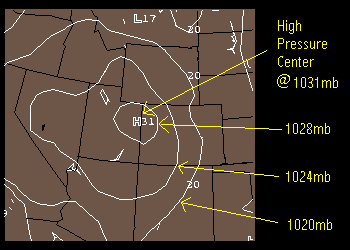
Isobars also show wind. Where they are packed close together the pressure changes quickly over a short distance and the wind is strong. Where they are far apart the wind is light.
Reading fronts
Fronts, troughs and squall lines are drawn with the standard symbols. See Weather front symbols for what each line means.
On this page
Related guides
- Weather Front Symbols
- Surface Prognosis Charts
- Weather Depiction Chart
- Aviation Surface Observations
- Decoding TAFs and METARs
- Station Weather Symbols
Need a hand?
Call (866) 469-9982, Monday through Friday, 8:00 to 4:00 Central, or email support@weathertap.com.