Decoding Guide
Lightning Data Tutorial
Abstract:
This chart depicts the location of recent cloud-to-ground lightning strikes.
Description:
This product depicts the locations and age of recent lightning strikes. The data originates
from land-based strike sensors located throughout the U.S. Note that this
image portrays 90% of cloud-to-ground strikes.
Issuance:
Continuously—The image is updated every 10 minutes. All strikes portrayed
are a minimum of 12 minutes old at the time of posting.
Data Sources:
Ground-based lightning detector network (USPLN).
Depiction:
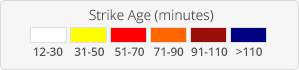
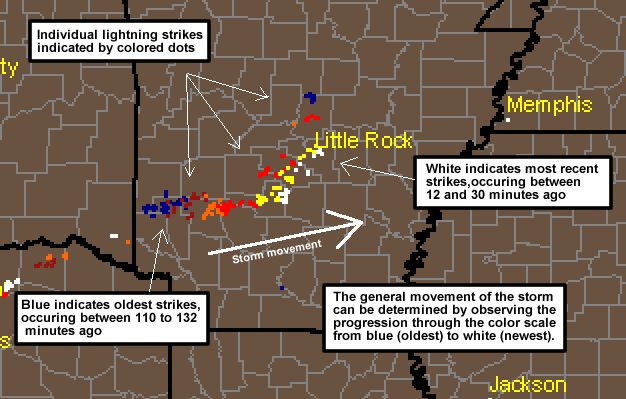
Each strike is depicted by a solid square symbol. The age of the strike is
depicted by changing the color of the symbol. After 132 minutes, the strike
is removed from the map.
Color code:
Example:
How it works:
When a lightning strike occurs a burst of energy is transmitted through the
atmosphere much like a radio wave from a transmitter. Unlike a radio wave,
however, lightning energy is not well ordered and spreads out across many
different EM wavelengths.
Lightning detectors work much like a AM radio receiving signals from a tower.
The detector contains special equipment that allows it to determine what
direction, relative to the detector, the lightning strike occurred. The detector
notes the polarity, amplitude, and exact time of the strike (determined by
an extremely precise, GPS synchronized clock), then transmits that information
back to a central hub. The detectors can detect strikes hundreds or even
thousands of miles away. Inevitably a strike within the coverage area will
be detected by multiple receivers, all of which transmit the strike data
and time back to the hub.
Computers at the hub examine the incoming data and correlate strikes based
on time and location. By using triangulation methods from the multiple detections,
the hub can determine the precise location (down to 250 meters) where the
strike occurred.
Data for all detected strikes are collected and transmitted from the lightning
data collection hub to the WeatherTAP Data Center. The WeatherTAP Data Center
continuously accumulates the data and renders a new lightning strike image
every 10 minutes.